





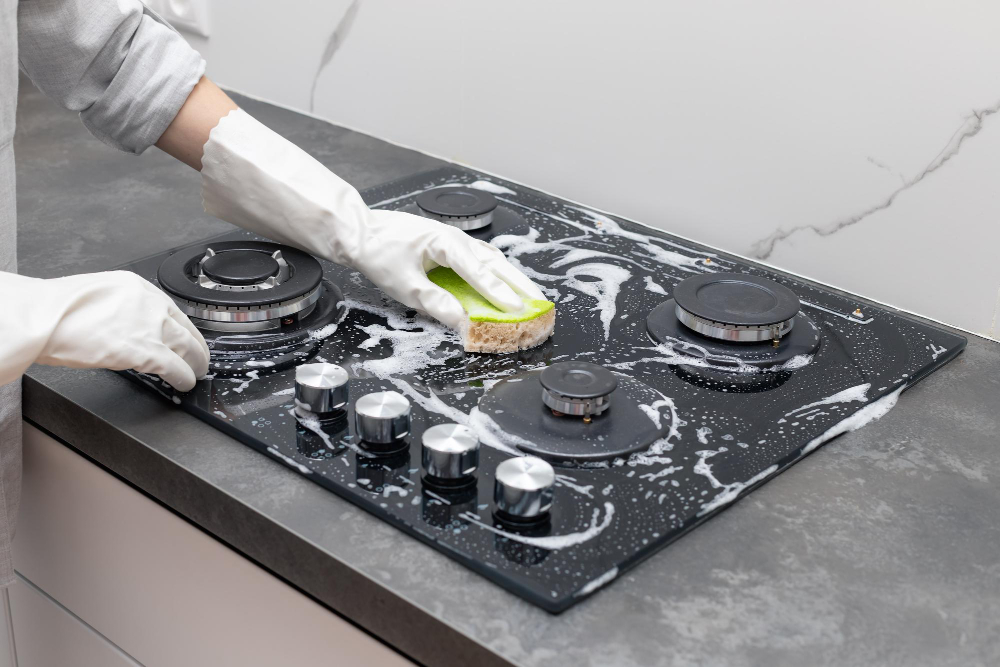
Glass stovetops get cleaned incorrectly more often than they get cleaned correctly. The instinct when you see a messy hob — grab whatever sponge is to hand and scrub — is precisely the wrong approach. The rough side of a standard kitchen sponge scratches a glass ceramic surface. Using any cleaning product on a hob that is still warm can crack the glass. And the burnt-on residue that builds up around the rings after a few weeks of regular cooking is not removable by scrubbing alone: it requires a specific tool and a specific technique.
This guide covers the right method for ceramic and induction hobs: what to use, what to avoid completely, how to deal with every type of residue from everyday grease to baked-on sugar, and how to keep the surface in better condition between cleans.
Ceramic vs Induction Hob: Is There a Difference in Cleaning?
The cleaning approach is identical. Both ceramic and induction hobs use a glass-ceramic surface. The difference is in how heat is generated — ceramic hobs heat the surface directly, induction hobs heat the pan through a magnetic field and the surface stays relatively cool. This means residue on an induction hob bakes on less aggressively, making routine cleaning slightly easier, but the method and products are the same for both.
Everything in this guide applies to both types.
What You Need
- A ceramic hob scraper — a dedicated razor blade scraper with a flat handle. This is not optional for dealing with baked-on residue. Do not try to substitute a standard kitchen knife or spatula.
- Ceramic hob cream or cleaner — Hob Brite, Bar Keepers Friend, or a good own-brand equivalent. Not all-purpose kitchen spray.
- Two microfibre cloths — one damp for cleaning, one dry for buffing
- White distilled vinegar in a small spray bottle
- Washing-up liquid
What not to use: steel wool, the rough side of a standard kitchen sponge, abrasive scourers, powder cleaners, bleach on the hob surface, or any product not rated for glass ceramic. Each of these leaves fine scratches that accumulate over time and make the surface progressively harder to keep clean. Once scratched, a glass hob cannot be un-scratched.
After Every Use: The Quick Clean (2 Minutes)
The most effective thing you can do for a glass stovetop is wipe it after every use, once it has cooled to room temperature. Residue that has not yet fully baked on comes off in under two minutes with a damp microfibre cloth and a drop of washing-up liquid. Left until the next cooking session, the same residue takes ten to fifteen minutes and a scraper.
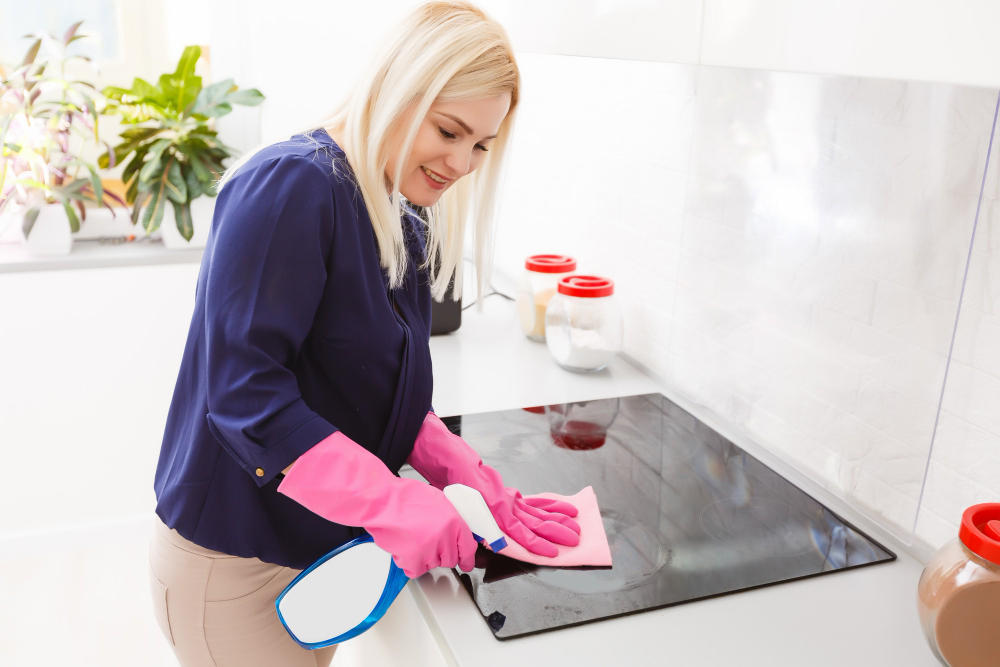
The quick clean routine: let the hob cool fully (do not rush this — a warm surface and cleaning liquid is a bad combination). Spray lightly with white vinegar. Leave two minutes. Wipe with the damp microfibre cloth. Buff dry with the second cloth. That is it. Under two minutes, and the hob stays in genuinely clean condition.
Most glass hob problems come from skipping this step for two or three weeks and then facing a build-up job rather than a maintenance job.
Deep Cleaning a Glass Stovetop: Step by Step
Step 1 — Wait until fully cool: Thirty minutes minimum after cooking. Never apply cleaning products to a warm hob surface.
Step 2 — Remove loose residue: Use a dry cloth or folded kitchen paper to remove loose crumbs and debris. For anything involving sugar — caramel, jam, anything that has melted and resolidified — do not apply liquid first. The scraper comes before liquid on solidified sugar residue.
Step 3 — Apply hob cleaner: Squeeze a small amount of ceramic hob cream onto the surface — about the size of a 50p coin for each affected area. Spread lightly and leave two to three minutes. Do not apply too much — a thin layer works better than a thick one.
Step 4 — Scrape baked-on residue: Hold the ceramic scraper at a shallow angle — around 30 degrees from the surface, almost flat. Apply firm, even downward pressure and push forward in short strokes. This lifts baked-on food and carbon deposits without scratching the glass below. Work from the edges of each deposit inward. For stubborn areas, re-apply hob cleaner and leave another two minutes before scraping again.
Step 5 — Wipe and buff: Wipe away the hob cream and lifted residue with the damp microfibre cloth, working in circular motions. Remove all product residue thoroughly. Buff completely dry with the second cloth. Any moisture left on the surface in a hard water area marks quickly.
Step 6 — Final check: Spray lightly with white vinegar, leave one minute, wipe clean. This removes any remaining light grease or cleaning product film and leaves a streak-free surface.
How to Remove Burnt Sugar from a Glass Hob
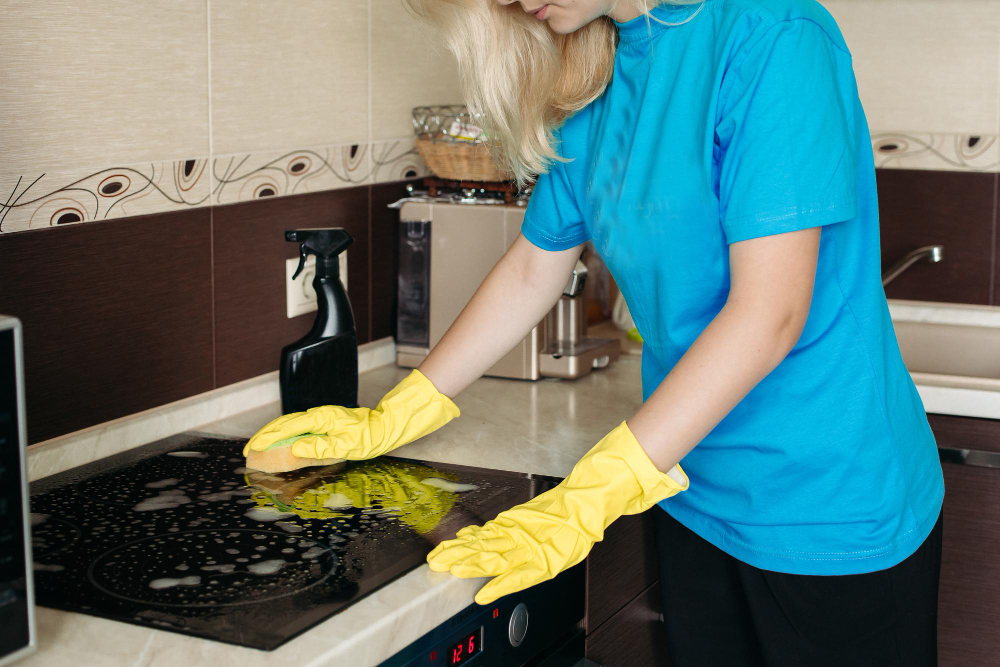
Burnt sugar is the hardest residue to deal with on a glass stovetop and the situation where most people either give up or cause damage by applying the wrong technique. When sugar melts onto a hot ceramic surface and then cools, it bonds to the glass at a molecular level. It cannot be removed by soaking or by standard cleaning products alone.
The correct approach: wait until the hob is completely and fully cool — not warm, not slightly warm, completely cold. Apply two or three drops of washing-up liquid directly to the burnt deposit and a small amount around the edges. Leave one to two minutes. Hold the ceramic scraper at the shallowest possible angle — almost completely flat against the surface, 10 to 15 degrees — and work slowly from the very edge of the deposit inward with short, careful strokes. The goal is to get under the edge of the residue and lift it, not to scrape across the surface.
Do not rush this. Working quickly or at too steep an angle causes scratches. Once the bulk of the deposit is lifted, clean the remaining residue with hob cream and the scraper as described in the step-by-step above.
Do not attempt to remove burnt sugar from a hob that is still warm. The sugar remelts and spreads, making the problem significantly worse.
Removing Grease and Oil Build-Up
Grease build-up around the rings — the slightly raised area of discolouration that forms around the hob elements over time — is a different challenge from baked-on food. It is a build-up of polymerised oil rather than a solid deposit, and it does not respond well to scraping.
For grease build-up: apply hob cream generously to the affected area and leave five minutes. Use the damp microfibre cloth to scrub in firm circular motions. If this does not fully shift it, apply hob cream again and leave ten minutes. Most grease build-up responds to this with one or two applications. For older, more established build-up, Bar Keepers Friend or a similar oxalic acid-based cleaner is more effective than standard hob cream.
Dealing With Discolouration and Heat Stains
Glass ceramic hobs sometimes develop a permanent-looking blue or grey tint in areas that have been exposed to very high heat — from oversized pans, from boiling-overs that sear onto the surface, or from pans left at maximum heat for extended periods. This is heat discolouration in the glass itself and is not removable by cleaning. It is cosmetic rather than functional — the hob works normally — but it is worth being aware that it cannot be cleaned away.
Regular use of correctly-sized pans and avoiding leaving high heat unattended reduces this.
How Often Should You Deep Clean a Glass Hob?
For a household that cooks regularly, a proper deep clean of the hob every four to six weeks is appropriate alongside the quick wipe-down after each use. If you only cook occasionally, every two to three months is reasonable.
The more consistently you apply the quick clean after every use, the less work the periodic deep clean involves. A hob deep cleaned monthly with good maintenance habits between cleans takes ten minutes. The same hob cleaned for the first time in three months takes 40 minutes.
When to Book a Professional Service
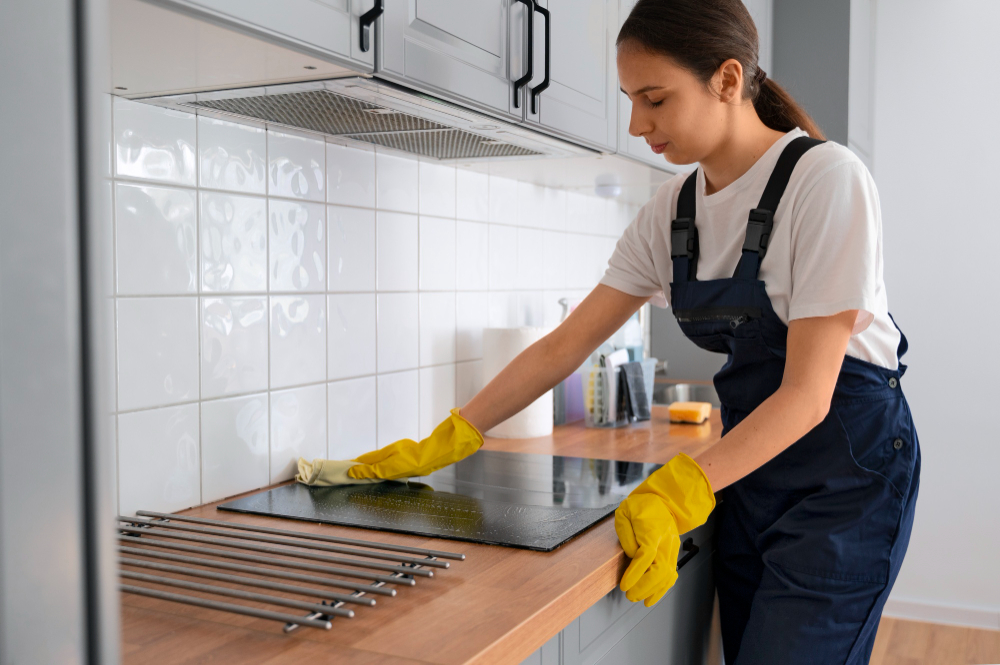
For rental properties approaching end of tenancy inspection, or hobs with significant accumulated grease build-up that DIY cleaning has not shifted, a professional oven and hob cleaning service is the more reliable option. Hobs flagged at checkout inspections are an avoidable deduction — typically £30 to £60 — that a £25 to £45 professional hob clean removes.
UrbanShine Cleaners covers all hob types including ceramic, induction, and gas alongside professional oven cleaning.
Protecting Your Hob Long-Term
A few habits that make a real difference to the long-term condition of a glass stovetop:
- Always use correctly-sized pans for each ring — pans wider than the ring cause heat to spread around the sides and bake residue into the surrounding area
- Never drag pans across the surface — lift them
- Avoid placing anything rough-bottomed directly on the hob — salt residue on the base of a pan, for example, scratches the surface when the pan is slid
- Apply a small amount of hob conditioner after every deep clean — most ceramic hob creams include a conditioning component, or a dedicated hob conditioner is available separately
- Deal with spills immediately when the hob cools — the same residue that takes two minutes to remove fresh takes twenty minutes after it has baked on at the next cooking session
Glass Hob Maintenance Across Seasons
Cooking habits change across the year, and the hob’s condition follows. The autumn and winter months — when more roasting, casseroles, and heavy cooking happen — are when glass hob surfaces tend to deteriorate fastest. Grease splatter from roasting pans, spills from slow-cooker-style dishes, and the residue from spice-heavy cooking all accumulate more quickly when cooking frequency and intensity increases.
A good habit for households that cook heavily in autumn and winter: increase the deep clean frequency to monthly rather than every four to six weeks, and be more diligent about the post-use wipe. A five-minute clean after a big cooking session is far more effective than trying to shift two months of accumulated residue at once.
Glass Stovetop Cleaning for Rental Properties
For tenants in London rental properties, the glass hob is one of the most closely examined appliances at checkout. Checkout inventory clerks assess hobs specifically — both the surface and the area around the rings — and the standard expected is ‘as clean as at the start of the tenancy.’ For a glass hob that has been used daily for a year or two, achieving that standard requires professional cleaning.
UrbanShine Cleaners’ oven and hob cleaning service at urbanshinecleaners.co.uk/oven-cleaning/ covers ceramic and induction hobs as part of the oven cleaning visit. The cost for a hob-only clean is typically £25 to £45 in London. Combined with a full end of tenancy clean, the hob is addressed as part of the kitchen scope.
Common Questions About Glass Hob Cleaning
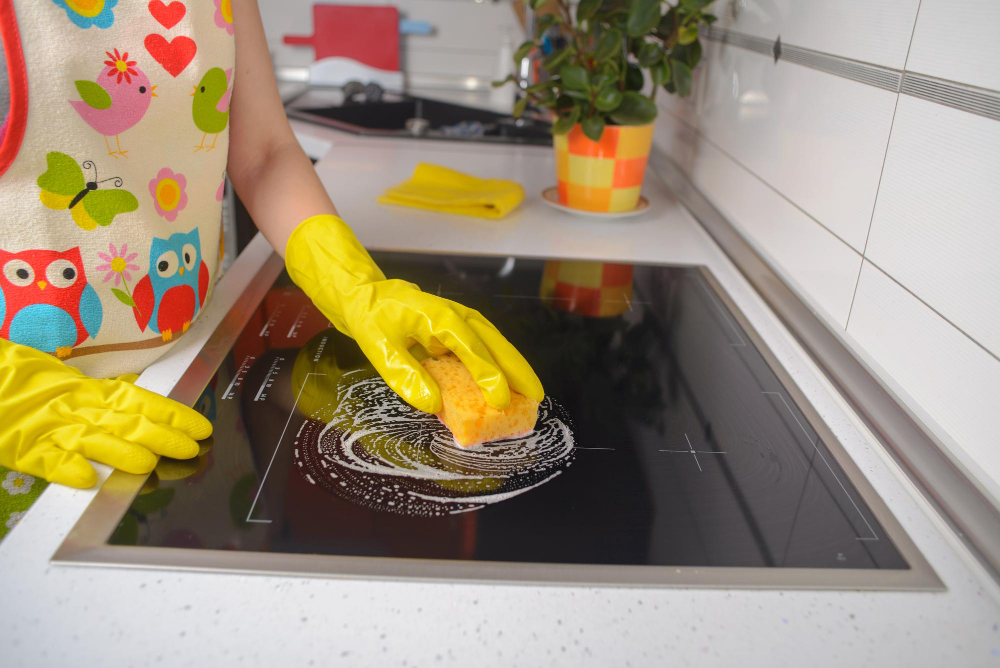
Can I use washing-up liquid on a glass hob? Yes, washing-up liquid and warm water is appropriate for routine light cleaning after cooking. It is not sufficient for baked-on residue or grease build-up — for those situations you need hob cream and the ceramic scraper.
Will vinegar scratch a glass hob? No. White vinegar is a mild acid and does not scratch glass ceramic. It is safe for regular use as a quick clean. Do not use undiluted malt or brown vinegar — these can leave residue.
Can I use a magic eraser on a glass hob? Magic erasers (melamine foam) are mildly abrasive and can leave fine scratches on glass ceramic with repeated use. They work in a single emergency situation but should not be the standard cleaning tool for a glass hob.
My hob has a brown or grey tint around the rings that does not clean off. What is this? This is heat discolouration in the glass ceramic itself, caused by sustained high heat exposure. It is not a cleaning issue — it is a permanent change to the glass and cannot be removed by any cleaning method. It does not affect function.
Frequently Asked Questions: Glass Stovetop Cleaning
Is it safe to use lemon juice on a glass hob? Yes. Lemon juice contains citric acid and is safe on glass ceramic. It works as a mild descaler and degreaser. It is less concentrated than citric acid powder and more expensive, but safe to use.
My glass hob has a crack. Can it be cleaned normally? A cracked glass hob should not be used or cleaned — there is an electric shock risk from water entering the crack. Contact the manufacturer or a qualified repair service before using or cleaning the appliance.
How do I remove a white film that will not come off with hob cream? A persistent white film is usually heavy calcium deposit from a boilover that has been left for some time. Apply a dedicated limescale remover (not bleach) to the film, leave five to ten minutes, then use the ceramic scraper at a very shallow angle. This is different from food residue and requires a different product.
Can the ceramic scraper be used on an induction hob? Yes. The glass ceramic surface of an induction hob is the same material as a ceramic hob and the scraper is safe to use on both. Use the same technique: very shallow angle, firm even pressure.
| Book professional hob and oven cleaning — all hob types covered across Central London, South London, and East London. |